
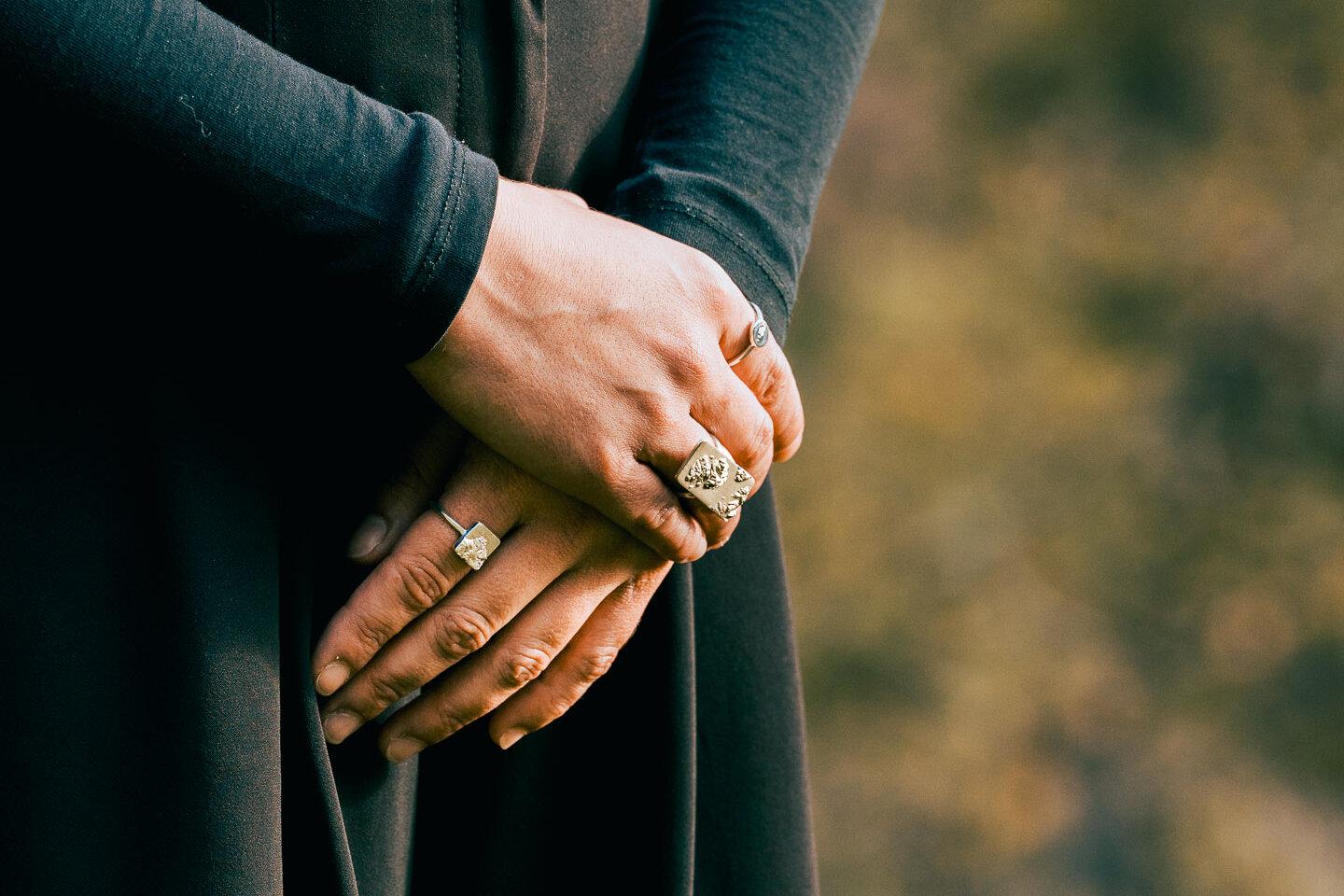
In short: Sterling silver is the most affordable and the softest: it picks up fine marks sooner and tarnishes, but it polishes back easily. Of the three golds, 9ct is the hardest and the palest, 18ct has the richest colour and is the softest, and 14ct sits between them. Every wildring.studio silver and gold piece is solid all the way through, never plated, and hallmarked at the Assay Office.
What is sterling silver, and is it real silver?
Yes. Sterling silver is 92.5% pure silver alloyed with 7.5% other metals, mostly copper, for strength. Pure silver is too soft for a ring worn every day.
The Royal Mint (opens in a new tab) gives sterling a minimum fineness of 92.5%. Under the Hallmarking Act 1973 (opens in a new tab), 925 is one of the four legal standards for silver (800, 925, 958 and 999). Every wildring.studio silver piece is hallmarked 925 at the Assay Office, which independently confirms the silver content.
What do 9ct, 14ct and 18ct mean?
The number is how many parts out of 24 are pure gold. Pure gold is 24 carat, so 18ct is 18 parts gold to 6 parts other metals (Royal Mint (opens in a new tab)).
- 9ct is 37.5% gold.
- 14ct is 58.5% gold. Fourteen parts in 24 works out at 58.3%, but the UK legal standard for 14ct is 585. So a hallmarked 14ct piece is at least 58.5% gold.
- 18ct is 75% gold.
The rest is other metals. For example, the refiner Cooksongold’s 9ct yellow casting alloy (opens in a new tab) is 37.6% gold and 10.3% silver, with the balance copper and zinc. Pure gold is too soft for many uses, which is why it’s alloyed. All three of our golds are solid gold throughout, not plated.
What do the hallmarks 925, 375, 585 and 750 mean?
They’re fineness marks: the parts of pure precious metal per thousand, as the Assay Office (opens in a new tab) explains. Each is a minimum: under the Hallmarking Act (opens in a new tab), a piece is only hallmarked if it’s at least the standard it’s marked with.
- 925: sterling silver, 92.5% silver
- 375: 9ct gold, 37.5% gold
- 585: 14ct gold, 58.5% gold
- 750: 18ct gold, 75% gold
A UK hallmark has three compulsory parts (opens in a new tab). These are the sponsor’s mark (who made or sent in the piece), the fineness mark, and the assay office mark (where it was tested). The Assay Office’s mark is an anchor. On a wildring.studio ring, the hallmark is struck inside the band before the ring is polished. The hallmark is your guarantee of the metal. In the UK, the law requires one on silver jewellery weighing 7.78 g or more and gold jewellery weighing 1 g or more.
Which metal is hardest and most scratch-resistant?
9ct gold, then 14ct, then 18ct. Sterling silver is softer than any of our gold alloys.
Lower-carat gold is harder and more scratch-resistant. The trade-off is colour: 9ct, the hardest, is also the palest.
| Metal | Purity | Hallmark | Colour | Hardness and scratch resistance | How it wears |
|---|---|---|---|---|---|
| Sterling silver | 92.5% silver | 925 | White; darkens as it tarnishes | Softest of the four | Marks sooner than gold; tarnish settles in the terrain recesses; polishes back easily |
| 9ct gold | 37.5% gold | 375 | Palest of the three golds | Hardest and most scratch-resistant | Can dull very slightly over years; a polishing cloth restores it |
| 14ct gold | 58.5% gold | 585 | Between 9ct and 18ct | Between 9ct and 18ct | Doesn’t tarnish |
| 18ct gold | 75% gold | 750 | Richest, warmest yellow | Softest of the three golds | Doesn’t tarnish |
How does each metal wear on a terrain ring?
The terrain can’t wear off any of them. It’s cast solid, so the landscape is part of the ring, not a layer on top of it.
What changes is the surface. Silver picks up fine marks sooner than gold. It slowly darkens as it reacts with air and skin, especially in the recesses of the contours. Many people like the depth that gives the terrain, and a silver cloth brings back the shine. 9ct gold can dull very slightly over years because of its higher copper content; a polishing cloth restores it. 14ct and 18ct gold don’t tarnish.
Does the colour of gold change with carat?
Yes. Higher-carat gold has a richer, warmer colour. 9ct is the palest yellow of our three golds and 18ct the deepest, with 14ct in between. All three are yellow gold.
Which metal suits an everyday ring?
All of them: every metal we offer is suitable for daily wear. For hard wear, gold outlasts silver, and 9ct is the most practical choice. 14ct balances colour and durability, and 18ct is the choice when colour and purity matter most. Sterling silver will mark sooner but polishes back, and its lower price makes it the most popular choice.
Weight is the other difference you’ll feel. Cooksongold lists its 18ct yellow casting alloy (opens in a new tab) at 15.5 grams per cubic centimetre, against 11.1 for 9ct (opens in a new tab). So the same piece is around 40% heavier in 18ct.
See every style in every metal on the shop page.
Can I have platinum, palladium, white or red gold?
Yes, on request: email hello@wildring.studio with your design and the metal you’d like. The Hallmarking Act (opens in a new tab) sets hallmark standards for platinum (850, 900, 950 and 999) and palladium (500, 950 and 999) too.
Plating and stone setting aren’t part of our making process, and our silver and gold pieces are solid metal throughout.
Rings and pendants
Every metal in this guide is offered for rings and pendants. A pendant comes as a Block, Charm or Circle, with a chain included. A silver pendant has a silver chain, and a gold pendant a gold one. The fineness standards and hallmarks above apply to a pendant as they do to a ring. The notes on wear and everyday use are written for rings.