
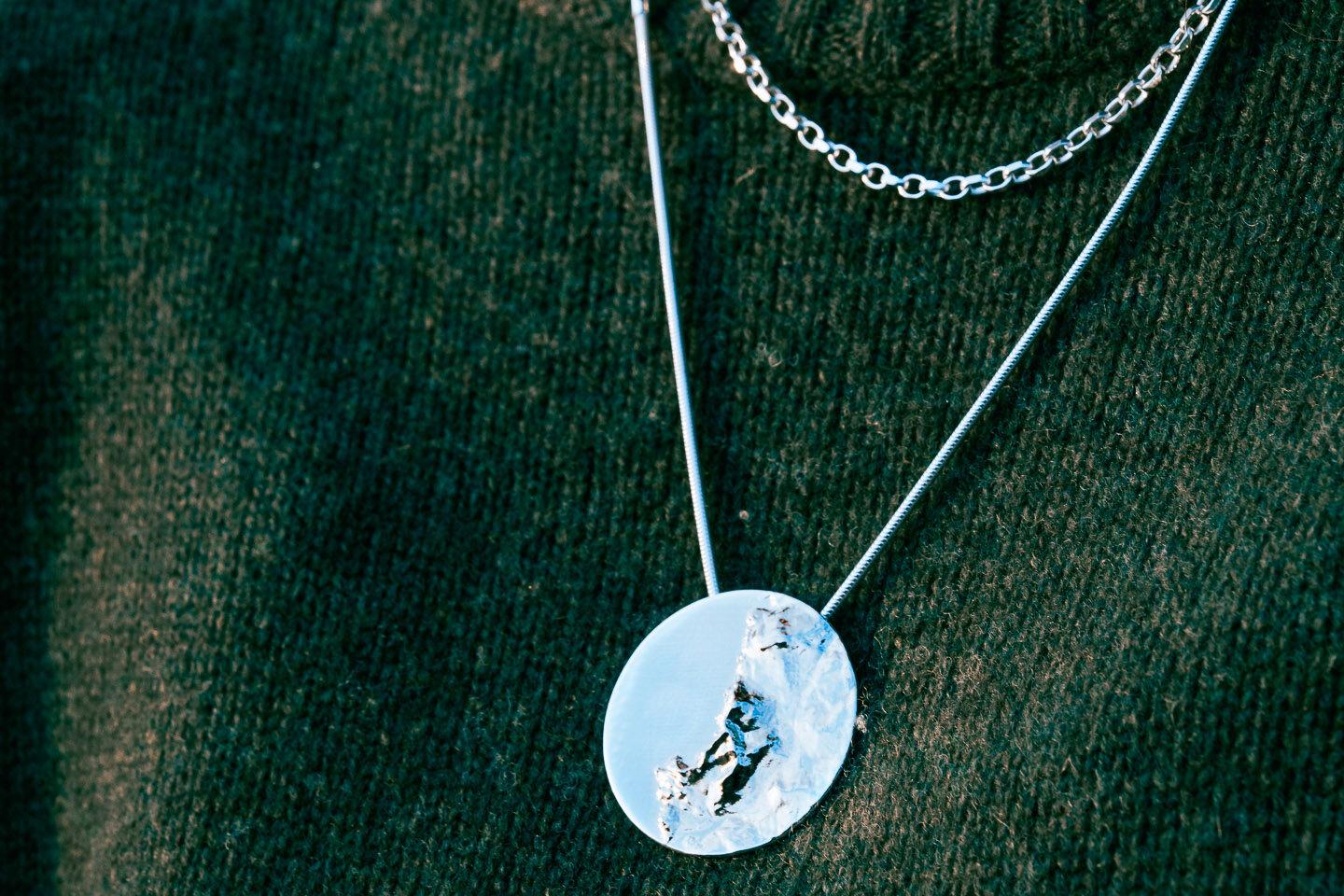
In short: There’s no single best: choose by look and by how the chain moves, and judge strength by thickness rather than style name. Trace is the simple one: oval links of equal length, each turned at right angles to the next. Curb is made of joined links, twisted and flattened, and is often a heavy chain. Snake is a flexible, ribbed tube of interlocking links; it can kink if bent sharply, so it needs storing flat or hanging straight. Every pendant comes with a chain in 18, 20 or 22 inch lengths.
wildring.studio offers trace, curb and snake chains. This guide explains how each one is made, how to choose a length and how to look after it.
What is a trace chain?
A chain of simple oval links of equal length, joined so that each one is turned at right angles to the next.
Harold Newman’s An Illustrated Dictionary of Jewelry (Thames & Hudson) defines a trace chain as simple oval links of equal length. They are joined alternately horizontally and vertically, so that the chain can lie flat. It lists several varieties, including the belcher.
It’s the lightest-looking of the three: fine, open and understated. It sits quietly behind the pendant, so the pendant does the talking. Traditionally it’s the classic choice for a delicate, feminine necklace, though it suits anyone who wants a chain that doesn’t draw the eye.
Best with: the Charm. The Charm hangs below its bail, and a fine trace chain lets it swing freely without competing with it.
What is a curb chain?
A chain of links that are twisted and flattened after they’re joined, so the chain comes out flat.
It’s the heaviest-looking of the three. The flat links lie close against the skin and catch the light, so the chain is part of the look as much as the pendant. It’s traditionally seen as the more masculine choice, though it’s worn by everyone.
Best with: the Block. The Block is our most solid shape, and a curb chain has the visual weight to match it.
What is a snake chain?
A flexible, ribbed tube made of interlocking links, so it reads as one line rather than separate links.
It’s the sleekest of the three. With no visible links it looks smooth and modern, with an even shine along its length. It looks solid but stays slim, and it’s the most neutral of the three: it doesn’t lean masculine or feminine.
Best with: the Circle. The Circle’s bail is on its back, so nothing interrupts its round outline, and a snake chain keeps that clean line going.
How does each chain hang a pendant?
A pendant hangs from its bail: above the Charm, inside the Block and on the back of the Circle. The first check is that the chain passes through it. How the pendant then moves depends on how the chain is made.
Trace and curb are made of separate links, so they move at every joint. A trace chain’s links are turned at right angles to each other; a curb chain’s are twisted and flattened. A snake chain is a single flexible tube, so it bends along its length as one piece.
Which chain comes with each pendant?
On our product pages, the Block is pictured on a curb chain, the Charm on a trace chain and the Circle on a snake chain. Those are the pairings we’d suggest: curb with the Block, trace with the Charm and snake with the Circle.
If you’d like to order a pendant on its own, or with a different type of chain completely, email hello@wildring.studio.
Which chain length should I choose?
Every pendant comes with a chain in 18, 20 or 22 inch lengths. It is a silver chain with a silver pendant and a gold chain with a gold one. The longer the chain, the lower the pendant hangs.
The surest guide is a necklace already worn by you or the person you’re buying for. Lay it flat and measure it from end to end, then choose the nearest length.
- 18 inch: about 46 cm
- 20 inch: about 51 cm
- 22 inch: about 56 cm
If there is no necklace to hand, our sizing guide shows how to measure with a piece of string.
Why do snake chains kink, and can it be fixed?
A snake chain’s links interlock to form a tube, so a sharp bend can leave a kink rather than falling straight again. A jeweller can sometimes fix one; don’t try to straighten it by bending it back and forth.
To avoid kinks:
- Store it flat, or hanging straight.
- Don’t fold it, coil it tightly or wrap it around anything.
- Keep it away from other chains, so it isn’t bent or crushed.
- Take a kink to a jeweller rather than working it yourself.
How do I clean a chain?
With warm water, a drop of washing-up liquid and a soft toothbrush, worked gently between the links. Then rinse it and dry it fully.
- Add a drop of washing-up liquid to a bowl of warm water.
- Brush the chain gently with a soft toothbrush. Work between the links of a trace or curb chain, and along the length of a snake chain.
- Rinse it in clean water.
- Pat it dry with a soft cloth, then lay it flat until it’s completely dry.
- Store it with the clasp fastened, apart from other chains.
Avoid harsh chemicals. For rings and pendants, our care guide covers cleaning, tarnish and storage.